
 Mindfulness
In the last several years, I have become aware of the importance of healthy relationship skills. These skills should be able to reach across time, gender and cultures. I do not know if we ever had these basic skills but I sense a pressing need for them more than ever. Maybe that is because our words now empowered by a global internet complete with video and audio can do so much good as well as so much harm. Words are now spoken – no longer face to face but through a computer or cell phone texting – where one never sees or feels the full effect of their words on the reader.
Without getting into some checklist of skills to have, I need to begin with me. My relationship with myself affects all my other relationships. If I am compassionate with myself, I will be compassionate with others. Compassion requires an understanding or awareness of what is happening in the present moment. The awareness is non-judgmental or unconditional in nature. It is a willingness ‘to feel with” or “empathize with” which is not dependent on a specific condition or outcome. It is not connected to time or space but the awareness exists in each present moment (or presence). Its power to transform exists in the present, not in past grudges or resentments and not in future expectations or worries.
How do I find in myself this non-judgmental awareness of the present moment, better known as Mindfulness. I have been told what I think is who I am. That’s always been a scary thought. My thoughts are precarious, racing from one to do list to the next. Hoping not to forget what I am supposed to do right now. Reacting to unexpected drama with the typical, fight, flight or freeze mentality.
Neuroscience can now show us through brain scans and experiments that are brain is hard wired to react to stressful and fearful conditions. We react usually without thinking. This is part of the evolutionary process which allowed us to survive potentially mortal situations by making quick decisions based on the stressful stimuli e.g., about to get eaten by a bear. In other words, modern stressful situations (like a traffic jam) bring about the same fight, flight or freeze reactions today as the bear did for our ancestors. In today’s modern world, we would hope to respond to a traffic jam with well thought out alternatives using our GPS and traffic reports instead of caveman road rage.
Neuroscience is now able to show us that the brain is also hard wired for compassionate behavior. We not only have our survival instincts but we also have the instinct to be compassionate to other humans, animals and our environment. Instead of being born selfish and only interested in our own survival, we now know we are born to be in relationships and have compassion built into our very nature. Thus compassion serves to create and sustain relationships which ultimately insure our survival. Darwin spoke of this compassionate nature more often than the survival instinct which received much more press.
Now I am armed with all this knowledge that tells me how the brain works but I still do not know how to choose the compassionate response over the typical emotional knee jerk reaction to stress.
Mindfulness or Awareness allows us to see ourselves having the caveman reaction but at the same time realizing there is another type of response possible – one of compassion or some other creative more appropriate response. This Awareness gives us the freedom to choose our actions and be responsible for them. This is a huge step to healthy relationships. This is a huge step to happiness on a personal level.
Mindfulness needs to be practiced in order to get our brain to work this way. The brain is now recognized as plastic or able to change itself. We can change the way we think and act through practice despite our genetics and even our past experiences. Breathing meditation is one of the most common but there are other ways to practice Mindfulness. In meditation practice, I focus on my breath while sitting quietly. Thoughts continue to come into my head. I am aware of the thoughts, let them go and refocus on my breath. This helps me be aware of my thoughts both reactive and responsive when in a stressful situation. The idea is if I continue to practice, it will be easier to choose to respond creatively from within a state of Awareness or Mindfulness.
The word Mindfulness is often associated with the Buddhists. However, this idea existed before there was Buddhism. In Chinese, the word mindfulness is translated as presence of the heart. Mind was often used by rabbis to convey the whole attitude and direction of life. In learning more and more about Mindfulness, I see much of it in my Roman Catholic traditions. Personally, I feel mindfulness is the divine whisper. Paul writes in his letter to the Phillipians, And the peace of God, which surpasses all understanding will guard your hearts and minds through Christ Jesus (Phillipians 4:7) In the Old Testament Psalms can be found the words, Be Still and Know that I am God. (Psalm 46:10) In practicing Mindfulness, I hope to see the divine in me responding to the divine in you.
Mary
P.S. If you would like to hear more about this topic, please click on the following link. http://being.publicradio.org/programs/2011/healthy-minds/
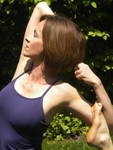
A Prayer Written in the Language of Your Body by Ellie Taylor
I never get tired of sharing my love of yoga. I appreciate that every time I come to the mat, it’s an opportunity to learn something new, providing rest and quiet for my mind while connecting with my body. I love that I can leave a practice feeling strong, yet soft. Centered, yet expansive. Energized, yet calm.
But can it be more than that?
Can we take this Eastern-influenced, new-age, earthy-crunchy practice called yoga and turn it into something for Christ?
I say yes, and it starts with your intention. When you set a clear intention, you can take the most familiar thing, and turn it into something for Christ. “When we use our bodies with spiritual intent, both our bodies and the occasion become sacred.”[1] Making dinner for your family can become holy, working in your garden can become holy, practicing yoga can become holy.
We also know that God desires you to care for your body. You are His greatest masterpiece, made in His image. Through yoga, you’re encouraged to respect the one and only body He has given you… to value your body as an instrument of God.
Yoga gives you the chance to be still. How often do we say that our prayer life suffers because we’re not able to slow down? Psalm 46:10 tells us to “Be still and know that I am God.” Come as you are to your yoga mat and be settled. Open yourself up to the presence of God. Don’t think of it as a “time-out” with the world, but more as a “time-in” with God… an opportunity to sit in His presence, listening for Him to speak to you in the silence.
Using your body in worship is not a new idea. Do you kneel and fold your hands when you pray? Do you offer the sign of peace to those around you in church? You can take the same idea to your yoga mat. Think of your practice as an offering, a prayer written in the language of your body.
A backbend becomes an opportunity to “lift up your heart to the Lord.”
A forward fold becomes an opportunity to “bow in humble adoration.”
Try it the next time you come to the mat. Stretch your body and your mind. Offer your spirit. Be playful. Be joyful. Show God that you delight in the gift of life He has given you.
Ellie can be found this summer teaching Anusara-Inspired Yoga at Elmhurst Yoga Shala, Tuesdays and Fridays from 9:30 – 10:45. In the fall, she returns to her full teaching schedule, including offering “Yoga From A Christian Perspective” classes with her good friend, Christy Hermann. Contact Ellie at
[1] Reclaiming the Body in Christian Spirituality, edited by Thomas Ryan